
The Los Angeles Dodgers are 26-18 and still on top of the National League West after a composed 5-2 win over the San Francisco Giants. The start is strong, even if the gap in the division has shrunk and the nightly margins feel tighter.
Everything is viewed through the lens of a potential three-peat. The Dodgers remain the heavy favorite to repeat as World Champions according to MLB betting at Bovada, and expectations around the league still align with their payroll and recent history. On the field, this looks like a veteran group easing from a hot opening month into the grind of a long season.
Dodgers Stay On Track
Forty-four games into the season, the Dodgers have already shown two clear phases. They opened 14-4 and, for a stretch, looked capable of turning the division race into a formality before Memorial Day. Since then, they have played closer to .500, with more one- and two-run games and fewer blowouts.
Despite splitting the series, tonight’s win over the Giants was a reminder of how this roster is built to win. The offense produced timely hits from stars like Teoscar Hernandez and depth players like Alex Call, rather than relying on a single outburst. Emmitt Sheehan, who occupies the fifth or sixth starter spot depending on who you ask, provided enough length to keep the game in control. The defense avoided the miscues that have cost them in a few recent losses.
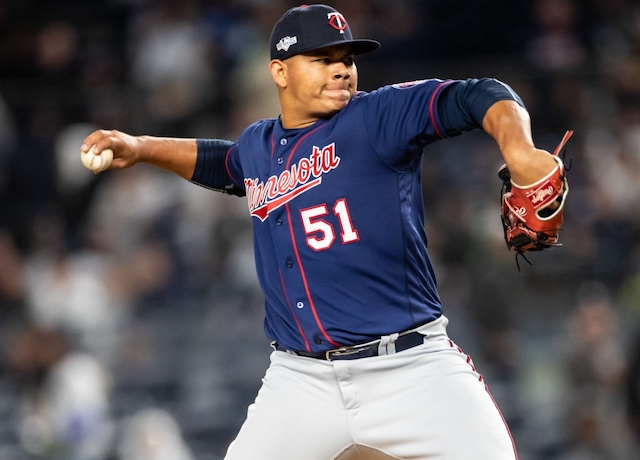
The bullpen, as it did for much of last season, operates largely by committee. Different relievers take the ball in the ninth depending on matchups and workload. It is less about replacing one defined closer and more about continuing the flexible approach that helped carry them through 2025. The result has been more steady than dramatic, even with late-inning roles shifting week to week.
Even with the offense struggling in May, the Dodgers’ run differential remains among the best in the league, and the roster depth continues to cover short-term injuries and cold streaks. For a team with championship expectations, 26-18 feels less like a surprise and more like a baseline.
2024: When Audacity Met Scrutiny
The 2024 season began under a brighter spotlight than usual. Shohei Ohtani signed a ten-year, $700 million deal. Yoshinobu Yamamoto followed with a twelve-year, $325 million contract. Tyler Glasnow’s five-year, $136.5 million extension pushed the commitment well past $1.1 billion before Opening Day.
The early results were solid but not overwhelming. Through a similar stretch, the Dodgers were 19-13. The offense led MLB in OPS at .781, powered by Ohtani, Freddie Freeman, and Teoscar Hernández. The pitching staff took longer to settle, and questions about depth and durability lingered into May.
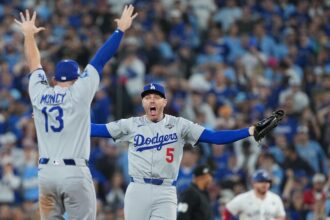
By the second half, the roster’s talent began to separate. Freeman remained the steadying force, and the rotation found a workable rhythm behind Yamamoto and Glasnow. The bullpen held enough leads to let the offense dictate games. The season ended with a five-game World Series win over the New York Yankees, which included a walk-off grand slam by Freeman in Game #1 that instantly became part of Dodger lore.
2025: A Trophy With Rough Edges
In 2025, the Dodgers actually started faster. They opened 21-10, the best early record of this current three-year window. The performance, though, felt uneven.
Andy Pages struggled out of the gate and was hitting .137 by mid-April. Max Muncy and Enrique Hernández also started slowly. Late-inning roles were fluid, with no clear, traditional closer. Leads held more often than not, but the path there rarely felt easy.
Shohei Ohtani’s return as a full two-way presence helped stabilize both the lineup and the rotation. Yamamoto provided reliable innings. Tommy Edman’s versatility allowed the Dodgers to mix and match, protecting struggling bats and covering defensive gaps. Over time, Pages adjusted and surged into an All-Star caliber run producer.
The Dodgers finished 93-69 and survived a seven-game World Series against the Toronto Blue Jays. It was the franchise’s first back-to-back championship, and it came despite long stretches where the team looked more gritty than dominant.
How 2026 Fits The Pattern
The 2026 Dodgers sit between those two seasons in both record and feel. At 26-18, they are ahead of the 2024 pace but behind the early surge of 2025. The shape of their season, though, is familiar.
The lineup spreads production across the order. Established stars continue to anchor key spots, while role players fill in around them and cover for slumps. The rotation has had its ups and downs in a post-Kershaw era, but has avoided extended collapses.
In the bullpen, the structure looks more like a continuation of last year than a radical shift. High-leverage innings are shared. Matchups dictate usage. The staff is not built around one iconic closer so much as a group trusted to get the final nine outs in different ways. That approach carries risk, but it also gives Dave Roberts flexibility across a long season.
The National League West race has tightened, with San Diego remaining within striking distance. That pressure reduces the margin for error while maintaining urgency in mid-May. For a team chasing a third straight title, the standard is clear.
The Dodgers are not trying to prove they belong among contenders. They are trying to stay there long enough and in good enough form to be the last team standing again in October.