

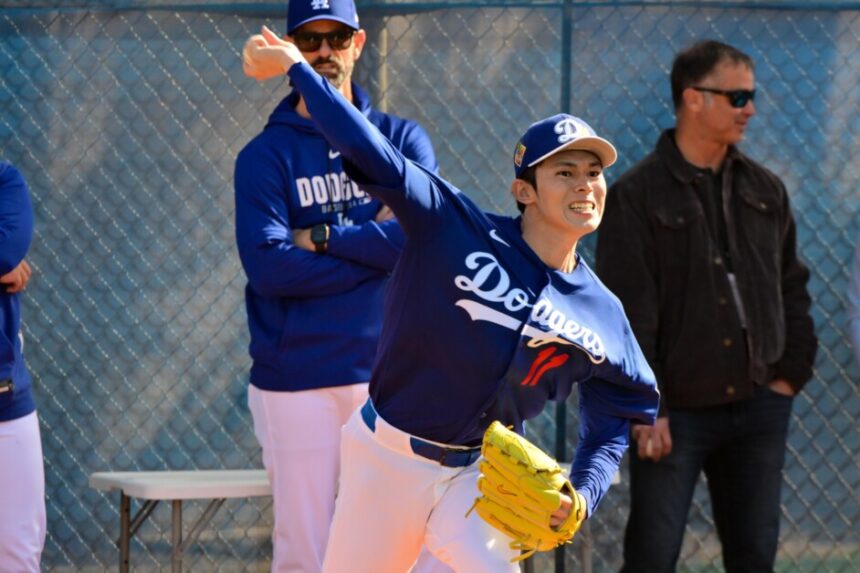
Roki Sasaki’s first full year with the Dodgers had its bumps, but the organization still sees him as an important part of their pitching plans beyond 2025. The focus in Los Angeles is on development, depth, and patience rather than panic, even as some outside voices speculate about trades and alternatives in high-profile Stake baseball matchups.
A year after choosing the Dodgers over the Blue Jays, Sasaki’s story has taken a few unexpected turns. Yet the club keeps coming back to the same core belief: at 24, with elite stuff and postseason experience, he remains a high-upside arm in a system built to support and insulate young pitching. The Dodgers have options to protect themselves in the short term while still allowing Sasaki to grow into the role they envisioned when they brought him over from Japan.
Sasaki’s Rookie Year In Perspective
Sasaki’s 2025 regular season line – a 4.46 ERA with 28 strikeouts over 36.1 innings in 10 appearances – came in waves, with promising stretches and bouts of uneven command. He was adjusting not only to Major League hitters but also to a new routine, travel, and workload. For a rookie making the jump from NPB, that type of up-and-down debut is not unusual.
What stood out to the Dodgers was not just the numbers, but the flashes: outings when his fastball-splitter combination overpowered lineups, and sequences in which he showed an ability to pitch out of trouble. The raw ingredients that made him one of the most coveted arms on the international market were visible, even if the consistency was not yet there from start to finish.
Postseason Role Showed His Ceiling
Those flashes became more visible when the Dodgers moved Sasaki to the bullpen in October. In that role, he simplified, attacked, and looked more like the dominant version of himself they saw in scouting reports and in Japan. He recorded multiple postseason saves, allowed only one earned run, and gave the Dodgers quality innings in high-leverage spots during their title run.
The strikeout-to-walk ratio in that sample was not perfect, but the damage control was. Sasaki handled pressure situations, showed poise on the postseason stage, and proved he could help a championship club in a meaningful way. That October run reinforced the belief that his stuff plays at the highest level and that his future can still be in the rotation once the mechanics and command catch up.
Early 2026 Spring: Growing Pains, Not A Verdict
This spring, Sasaki’s line in a couple of outings has jumped off the page for the wrong reasons, including a rough appearance against the Diamondbacks and another start that got away from him early. The command wobbled, the walks piled up, and the box score looked ugly in a small sample.
But those games also included encouraging sequences. He missed bats with his fastball–splitter mix and flashed the swing-and-miss ability that made him such a big-ticket signing. After a tough frame in one outing, he came back later in the game and responded with cleaner innings, including “three up, three down” work that offered a glimpse of how different the narrative looks when he opens with that version of himself.
For the Dodgers, those contrasting looks highlight the central question with Sasaki: not whether the stuff plays, but how quickly he can harness it consistently.
Why The Dodgers Are Staying Patient
Public reporting and commentary about the team point to patience with Sasaki rather than a rush to move on. The Dodgers have a long track record of taking talented pitchers, cleaning up their mechanics, and slotting them into roles that give them a chance to succeed. That history helps explain why, even after a bumpy spring, the tone around Sasaki remains measured.
Manager Dave Roberts and the coaching staff have pointed to overthrowing and fastball command as likely issues this spring, rather than any deeper concern about his raw ability. Mechanical adjustments are already a focus, and the Dodgers are betting that, with time and reps, those tweaks will translate into more efficient innings and deeper starts as the season progresses.
Trade Talk And Depth, Not Replacement
Outside proposals have linked the Dodgers to a potential trade with the Blue Jays for veteran left-hander Eric Lauer. On paper, Lauer’s recent production, versatility, and ability to start or work out of the bullpen would add another layer of depth behind the front of the Dodgers’ rotation. Conceptually, an arm like that makes sense for a club chasing another title.
But that kind of move, if the Dodgers ever decide to explore it, would be about insulation, not replacement. Sasaki’s age, contract status, and upside make him far more likely to be part of the long-term picture than a short-term trade chip. Any depth addition would allow the Dodgers to manage his workload, adjust his role if needed, and take pressure off him to be perfect every fifth day while he is still learning the league.
Development Pathways Still Open
The Dodgers also have internal levers they can pull if they want to recalibrate Sasaki’s path without closing the door on his future in the rotation. They could again use him in the bullpen for stretches, where his stuff plays up in shorter bursts, or give him time with Triple-A Oklahoma City if they feel he would benefit from a different setting to lock in his mechanics.
Those possibilities are not punishments; they are standard steps for an organization that consistently develops pitching. Plenty of successful starters have taken detours through the bullpen or the minors before settling in as reliable rotation pieces. Given Sasaki’s age and profile, those options are safety nets, not red flags about his long-term future.
Why Dodgers Fans Can Stay Optimistic
For Dodgers fans, it is understandable to be concerned about the spring stat lines and some early hiccups. It is also important to zoom out. Sasaki is just entering his second Major League season, coming off a year that already included meaningful postseason contributions and experience on a World Series roster. He remains surrounded by a coaching staff and pitching group that knows how to navigate early-career bumps for young arms.
The Dodgers did not sign Sasaki for a single season. They brought him in because they believe his ceiling, with time and refinement, fits their championship ambitions over the next several years. Spring training struggles do not erase that evaluation. If anything, they highlight why the organization’s depth, patience, and willingness to adjust roles are key to how they plan to help him reach that ceiling.