

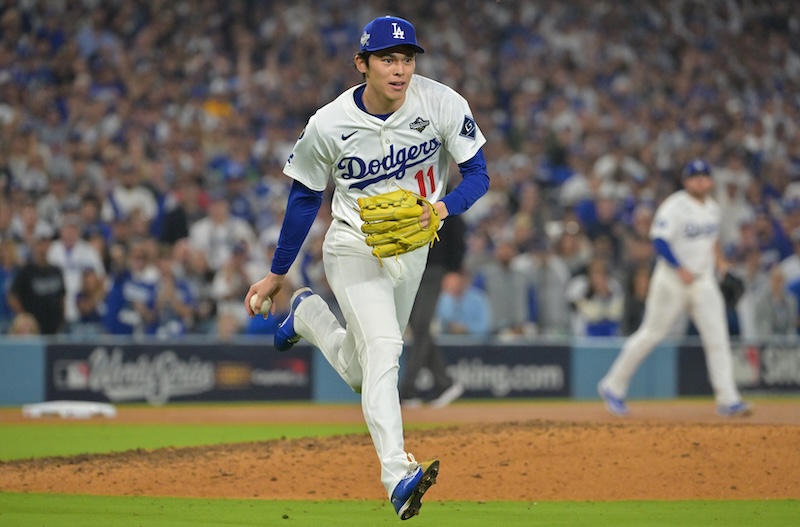
Roki Sasaki’s first season with the Los Angeles Dodgers did not unfold as the front office or the right-hander expected. The rookie opened 2025 in the starting rotation but battled inconsistency and a right shoulder injury before ultimately reinventing himself as a dominant reliever by season’s end. Now, as Spring Training ramps up, the Dodgers are moving him back into the rotation with an eye on long-term upside rather than short-term comfort.
That shift comes with clear priorities. Sasaki and the Dodgers’ coaching staff know the stuff is electric, but they also know the margin for error shrinks when he turns a lineup over multiple times. As betting markets and outlets like The Lines.com evaluate how the Dodgers’ pitching staff stacks up this season, Sasaki’s ability to convert his bullpen success back into rotation value looms as one of the club’s biggest variables.
Struggled as a Starter
The 24-year-old’s rookie numbers as a starter tell the story of an arm that never fully clicked. In eight games before his shoulder injury, Sasaki posted a 4.72 ERA and 1.49 WHIP, struggling to work deep into outings and often fighting his delivery. His four-seam fastball and splitter remained foundational pitches, but the fastball lost life as his shoulder barked, and his command never settled in. When he fell behind in counts, hitters could sit on the heater, and his best weapon, the splitter, never came into play often enough.
A mid-May shoulder issue shut him down and led to a 15-day injured list stint that stretched into more than four months. Sasaki did not return to the Dodgers’ active roster until late September, and when he did, it was in a new role. Moved into the bullpen, he simplified his approach, attacked the zone, and saw his velocity tick back up. Shorter stints let him lean heavily on his fastball-splitter combination, and the results were immediate: more swings and misses, crisper tempo, and outings that looked far closer to the ace profile that made him a sensation in Japan.
Coming Out of the Bullpen
That late-season surge out of the bullpen gave the Dodgers a high-octane relief weapon entering October, but it did not change the organization’s long-term view. The team still believes Sasaki’s ceiling is the highest as a starting pitcher, and manager Dave Roberts has been direct about what needs to change to make that happen. The message has centered on one theme: he needs a reliable third pitch that gives hitters a different look and helps him navigate lineups more efficiently.
Sasaki has embraced that challenge. Speaking recently through an interpreter, he explained that he is working on both a cutter and a two-seam fastball to expand his repertoire. The additions are designed to complement his four-seam fastball and splitter rather than replace them. The cutter offers movement that runs away from left-handed hitters and can jam right-handers, while the two-seamer gives him an option that moves arm-side and potentially generates more early-count contact on the ground.
Two Pitches Not Enough
During his rookie season, Sasaki leaned heavily on the four-seamer and splitter, with both pitches showing flashes but rarely working in sync. The splitter graded as a plus offering when he was ahead in the count or able to land it for strikes, but those situations were inconsistent. Too often he fell behind, was forced back to the fastball, and could not consistently locate it at the top or bottom of the zone. The result was longer innings, elevated pitch counts, and outings that ended earlier than the Dodgers wanted.
Adding a third and even a fourth look could act as a release valve for those stressful innings. A cutter that hitters must respect on the edges of the zone can change eye levels and tunnel off the four-seam fastball. A two-seamer that bores in on the hands gives him a different shape to attack the middle of the plate without relying solely on velocity. If Sasaki can land both pitches for strikes, they could bridge the gap between his overpowering best and the consistency required of a Major League starter.
Getting and Staying Healthy
Sasaki understands the work extends beyond pitch design. He has been clear that refining his mechanics sits at the top of his checklist for 2026. He wants his delivery to repeat from pitch to pitch, allowing him to stay on line to the plate and reduce the effort needed to generate his upper-90s velocity. He has talked about “being efficient” with his motion, an approach that should help both his command and his ability to handle a full starter’s workload over six or seven innings.
The physical side remains just as important. After dealing with a shoulder issue that derailed his rookie campaign, Sasaki has focused on strength and conditioning, emphasizing durability. He has mentioned that his goals include building up general strength while maintaining the flexibility and mobility that support his delivery. That includes attention to specific areas, like his groin, which plays a key role in driving off the rubber and stabilizing his lower half through release.
Sasaki described it as regaining his body’s functionality, ensuring each part worked in concert rather than fighting the rest of his mechanics. For a pitcher with his long levers and explosive movement, even small breakdowns can lead to timing issues, lost velocity, or command lapses. By targeting those details, he hopes to keep his delivery in sync, protect his shoulder, and maintain his stuff deeper into games.
Wait and See Approach
The Dodgers will likely manage his workload carefully early in the season. After last year’s injury and the shift to the bullpen, building him back up as a starter will require a balance between aggression and caution. That could mean shorter early-season outings, extra rest between starts, or occasional opportunities to skip a turn if needed. The club has depth options, but the preference is clear: they want Sasaki to seize a rotation spot and hold it.
For Sasaki, the path is straightforward even if the execution is not. He needs to carry over the confidence and aggression he showed in the bullpen, pair it with improved mechanics, and make his new pitches reliable enough to trust in leverage counts. If he does, the version of Roki Sasaki that emerged late last season could be a preview rather than a peak, and the Dodgers’ rotation could gain another front-line caliber arm at a time when every contending team is searching for one.
How quickly that transformation takes shape will be one of the early storylines of the Dodgers’ 2026 campaign. The organization has seen what Sasaki looks like when everything is in sync. Now the challenge is to sustain that level over a full season in the rotation, with a deeper arsenal, a healthier body, and a clearer plan for attacking big league lineups every fifth day.