

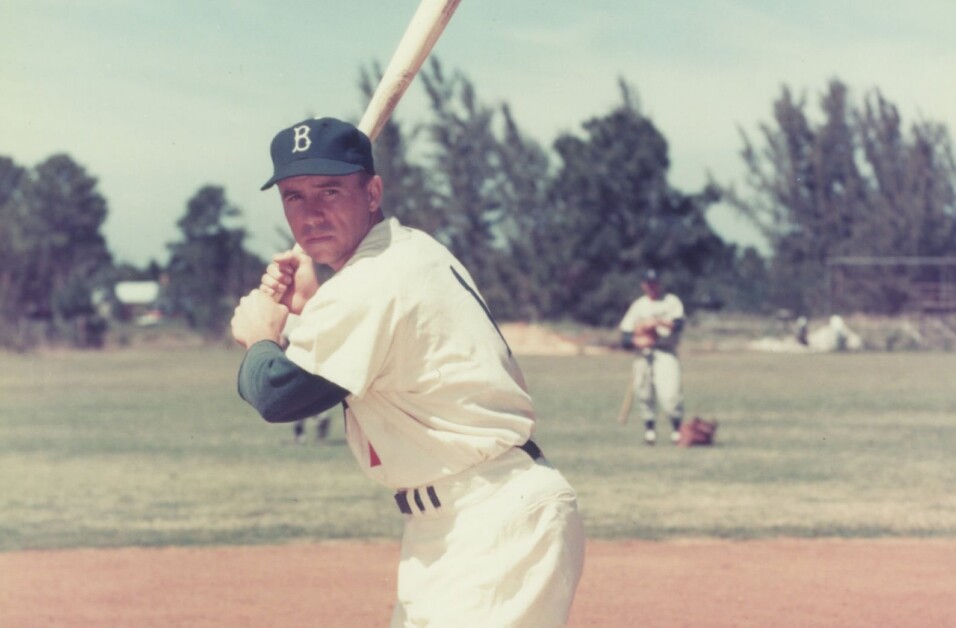
Pee Wee Reese remains one of the most important figures in Los Angeles Dodgers history, even decades after his playing career ended. The Hall of Fame shortstop helped define the franchise’s identity through leadership, consistency, and quiet authority during its Brooklyn era and transition west.
Late in life, Reese faced serious health challenges, including lung cancer, which he battled after undergoing surgery and radiation treatments beginning in 1997. Despite those struggles, his impact on the Dodgers and Major League Baseball never faded, anchored by his role as captain of championship-caliber teams and a key figure during a transformative period in the sport.
Early Life and Rise with the Dodgers
Harold Peter Henry Reese was born on July 23, 1918, near Ekron, Kentucky, and raised in Louisville. He earned the nickname “Pee Wee” as a standout marbles player before turning his focus to baseball. His strong infield play and instincts drew attention from scouts, and he eventually signed with the Dodgers organization.
Reese made his Major League debut on April 23, 1940, and quickly established himself as the team’s everyday shortstop. By 1941, he had taken full control of the position, helping anchor an infield for a Dodgers team that was beginning to emerge as a National League contender.
War Service And Leadership Role
Reese’s career paused during World War II when he served in the Navy from 1943 to 1945. He returned in 1946 and immediately resumed his role as the Dodgers’ on-field leader. His awareness, positioning, and steady play made him an extension of the manager.
From the late 1940s through the mid-1950s, Reese served as captain of the “Boys of Summer.” The Dodgers won National League pennants in 1947, 1949, 1952, 1953, 1955, and 1956 during that stretch. Their breakthrough came in 1955, when Brooklyn defeated the New York Yankees in seven games to win the World Series. Reese handled the final out at shortstop, a defining moment in franchise history.
Production And Defensive Excellence
Reese was not known as a power hitter, but he consistently produced at the top of the lineup. Across 16 seasons with the Dodgers from 1940–42 and 1946–58, he compiled a .269 batting average with 2,170 hits, 126 home runs, and 885 RBI. He scored 1,338 runs and drew 1,210 walks, showing strong plate discipline and on-base ability.
He led the National League in walks in 1947, runs scored in 1949, and stolen bases in 1952. Reese also finished in the top 10 of MVP voting eight times, reflecting the high esteem he was held in by peers and voters.
Defensively, Reese set the standard at shortstop. He led National League players at his position in putouts four times and double plays twice. His .977 fielding percentage in 1949 highlighted his reliability. His partnership with Jackie Robinson formed one of the most effective double-play combinations of the era.
Impact Beyond The Field
Reese’s legacy extends beyond statistics. He played a critical role in supporting Robinson during the integration of Major League Baseball in 1947. At a time of intense pressure and hostility, Reese publicly stood by his teammate, helping ease tensions and set a tone inside the clubhouse.
When the Dodgers moved to Los Angeles in 1958, Reese remained with the team for his final season. Though his playing time had decreased, he provided veteran leadership during a period of major change for the organization.
After retiring, Reese transitioned into broadcasting. He became a familiar voice on national telecasts and remained closely tied to the Dodgers and the sport. His calm demeanor and deep understanding of the game made him a respected analyst.
Final Years And Lasting Legacy
Reese was inducted into the National Baseball Hall of Fame in 1984, recognition of a career defined by leadership as much as performance. His contributions helped shape one of the most successful periods in Dodgers history.
In his later years, Reese dealt with multiple health issues. He previously underwent treatment for prostate cancer and later faced a more serious diagnosis. In 1997, doctors identified lung cancer, leading to surgery to remove a malignant tumor, followed by weeks of radiation treatment.
Reese died on August 14, 1999, at the age of 81. His legacy remains firmly tied to the Dodgers, where he still ranks among the franchise leaders in runs and walks. More importantly, he is remembered as a steady presence who guided the team through both success and significant change.
For the Los Angeles Dodgers, Reese represents a standard of leadership that extends beyond numbers. His influence continues to resonate across generations of players and fans.