

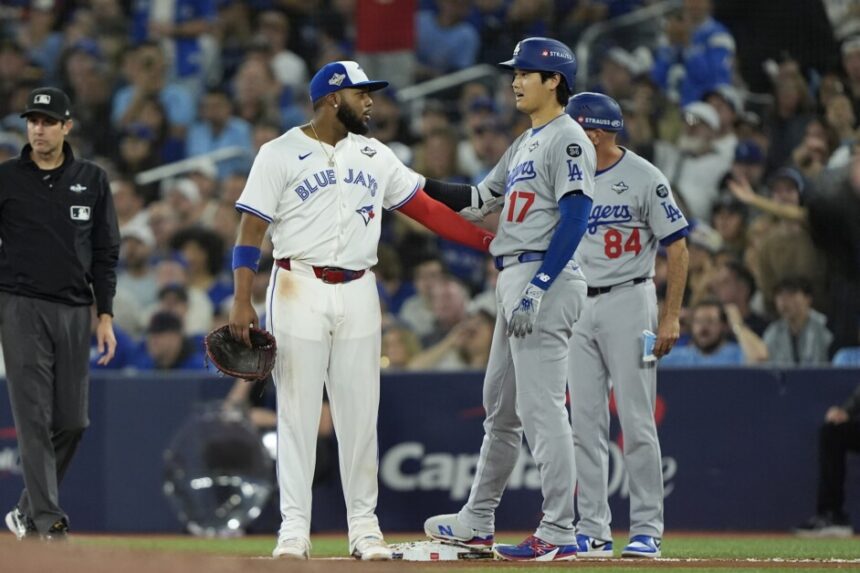
Shohei Ohtani’s record 10-year, $700 million contract with the Los Angeles Dodgers reset how front offices think about paying a franchise player. Vladimir Guerrero Jr.’s 14-year, $500 million extension with the Toronto Blue Jays pushed that conversation in a different direction, pairing massive money with a traditional, no-deferral structure. Together, the two deals show how teams are reshaping star contracts to match both competitive windows and market realities.
The numbers jump off the page, but the structure behind them tells the real story. Ohtani’s deal leans on unprecedented deferrals that slash the Dodgers’ immediate cash hit, while Guerrero Jr.’s extension is a straightforward, high-guarantee pact that pays steadily across the full term. Even compared to something like doge casino posting novelty odds on record-breaking contracts, these details show what front offices actually value when they decide to invest half a billion dollars or more in a single player.
Ohtani’s Contract as Roster Tool
On paper, Ohtani’s contract looks simple: $70 million per season through 2033 with the Los Angeles Dodgers. In practice, it is one of the most complex star deals in league history because of its deferral structure. Reports indicate Ohtani is only collecting 2 million dollars per year during the playing term, with 680 million deferred into the 2034–2043 window. That pushes most of the cash commitment a decade into the future and turns the contract into a cap-management weapon instead of just a salary line.
For competitive purposes, that distinction is huge. The present-day value of the contract for competitive balance tax calculations sits closer to 460 million, which means Ohtani’s annual CBT hit is roughly $46 million rather than the full $70 million. That gap creates real breathing room as the Dodgers layer Ohtani’s deal on top of existing long-term commitments to Mookie Betts and Freddie Freeman. It is no coincidence that Los Angeles continued to spend aggressively in the winters after Ohtani signed. The structure was built to allow that.
The deferrals also shape how Ohtani’s value is framed. He is not just a two-way superstar who can anchor a lineup and, once healthy enough to pitch full-time again, a rotation. He is part of the Dodgers’ roster architecture. By limiting his near-term salary hit, the contract makes it easier for the front office to attack multiple needs at once, from starting pitching depth to bullpen upgrades and mid-tier lineup additions. The deal effectively turns his own future earnings into present-day flexibility.
That flexibility, however, does not erase risk. Deferrals do not disappear from the books; they move to a different part of the timeline. If Ohtani’s production slips late in the contract or injuries limit his two-way impact, the Dodgers will still be paying out large sums long after he leaves his prime. The organization has essentially bet that Ohtani’s global marketing power, on-field ceiling, and impact on franchise revenues will justify both the near-term CBT hit and the long tail of deferred payments.
Guerrero Jr. Deal Prioritizes Certainty
Guerrero Jr.’s 14-year, 500 million dollar extension with Toronto lands in the same financial neighborhood, but the Blue Jays approached the problem from the opposite direction. Multiple outlets have reported that the contract carries no deferrals, no opt-outs and a full no-trade clause, with a significant signing bonus spread across the life of the deal. For the club, that framework trades some short-term payroll relief for a simpler, more predictable commitment.
The impact is immediate. Guerrero Jr. was approaching his walk year in 2025, with the potential to headline a loaded 2025–26 free agent class. The extension removes that drama and locks him to Toronto through 2039, covering his age-26 through age-40 seasons. It also turns him into the long-term face of Canada’s only MLB franchise at a moment when the Blue Jays have been trying to solidify their competitive core.
The lack of deferrals means Guerrero Jr.’s annual average value, around 35.7 million dollars, aligns more closely with the actual cash outlay each season. There is no hidden back end. For a club that operates in a single-country market and faces unique media and tax dynamics, that kind of clean contract has value. It helps internal budgeting, simplifies year-to-year CBT calculations and reduces the chance that the team will still be paying Guerrero Jr. long after his playing days end.
At the same time, the structure amplifies performance risk. Unlike Ohtani’s deferral-heavy deal, which buys the Dodgers more short-term wiggle room, Guerrero Jr.’s contract will hit Toronto’s books in a straightforward way for 14 consecutive seasons. If his offensive numbers stagnate or defense becomes a concern as he ages, the Blue Jays will carry the full annual burden. The club’s bet is that a four-time All-Star with a track record of middle-of-the-order production and a national profile in Canada will remain worth that investment through enough of the term to justify the total number.
How Their Deals Reshape the Market
Ohtani and Guerrero Jr. sit next to Juan Soto at the top of the modern salary table, but they represent different philosophies. Soto’s 15-year, 765 million dollar deal with the Mets is a pure scale play built on age and elite plate discipline, buying as many prime seasons as possible in one stroke. Ohtani’s contract emphasizes creative structure and marketing reach as much as on-field production. Guerrero Jr.’s extension leans into stability, continuity and classic guaranteed money.
The key difference is how each contract interacts with team-building. The Dodgers use Ohtani’s deferrals to maintain flexibility around a star-heavy core that is built to chase championships every season through the early 2030s. The Blue Jays use Guerrero Jr.’s clean, no-deferral deal to anchor a specific identity: a homegrown slugger who can connect a generation of fans to the franchise and keep the club competitive in the American League race. The numbers may be similar at the top line, but the mechanics show that the teams are buying slightly different things.
For players, these deals also redefine bargaining expectations. A young superstar or emerging MVP candidate can now point to multiple paths to a 500 million dollar payday. One route is a deferral-heavy, structure-first approach that maximizes overall headline value and helps the team manage the cap. Another is a traditional, fully guaranteed extension with limited structural wrinkles but strong no-trade protection and immediate cash flow.
For clubs, the Ohtani and Guerrero Jr. contracts highlight the tension between short-term payroll flexibility and long-term certainty. Deferrals can help teams like the Los Angeles Dodgers stack star talent without immediately overwhelming the CBT ledger, yet those choices create obligations that will stretch across future competitive windows. Straightforward deals like Guerrero Jr.’s compress the risk into the playing term but demand confidence that the player’s performance and off-field value will sustain over a decade or more.
Regardless of the path chosen, the top end of the market looks different now. Massive sums are no longer simply rewards for what a player did in arbitration years or early free agency. They have become tools to shape how a franchise operates, how it presents itself to fans and how it plans its roster through the 2030s. Ohtani’s deferral-driven structure with the Dodgers and Guerrero Jr.’s traditional extension with the Blue Jays will be reference points the next time a superstar in his mid-20s sits down to talk about the price of a prime.