

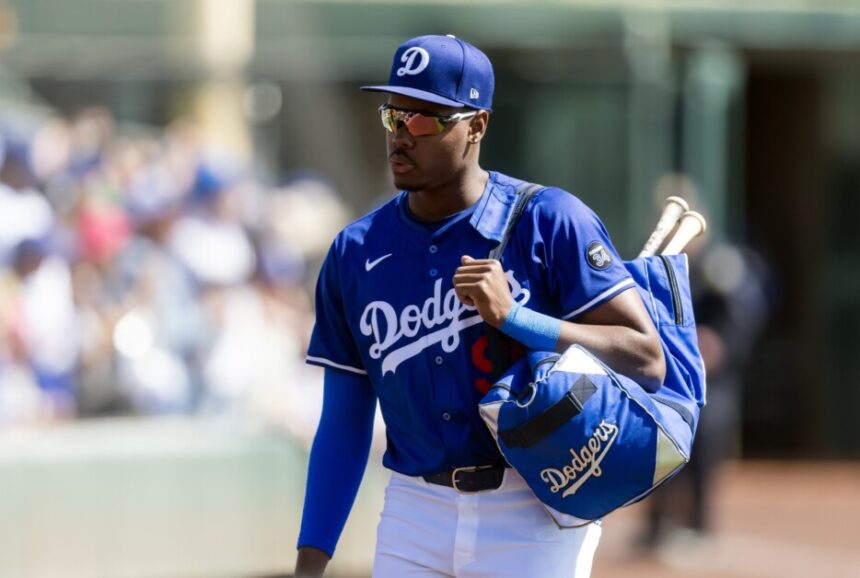
The Dodgers built their recent run of success on more than star power and a record payroll. They also kept a steady stream of young talent ready to step in when needed, and 2026 is no different. Three outfielders now sit at the top of the system, giving Los Angeles another wave of upside on the way.
Prospect talk now overlaps with baseball-adjacent entertainment in new ways. Fans track video clips, leaderboards, and even player props in the same window, and some will scroll sites like Goldzino while refreshing minor league box scores and prospect reports. The focus, though, remains on what the next group of Dodgers can bring to the big league club.
Dalton Rushing has already graduated from prospect status and now backs up Will Smith on the 2026 Opening Day roster, giving the Dodgers a left-handed bat with power and on-base skills behind the plate and at first base. He debuted in 2025 and opened 2026 with an early power surge, quickly reminding evaluators why he once ranked near the top of industry lists.
Top Of The System: De Paula, Hope, Quintero
Most public rankings now stack the Dodgers’ system with three outfielders at the top in some order: Josue De Paula, Zyhir Hope, and Eduardo Quintero. MLB Pipeline currently lists De Paula, Hope, and Quintero as the club’s top three prospects, all outfielders who project to reach Los Angeles within the next few seasons. Other outlets, such as Baseball America and The Athletic, vary on the exact order, but the same three names appear near the top of every major Dodgers list.
Eduardo Quintero even drew the No. 1 ranking in Baseball America’s preseason Dodgers list for 2026, edging out De Paula while Hope landed a few spots behind them. Analysts generally agree that this trio forms the core of the next position-player wave, with all three already appearing on various league-wide Top 100 lists. That kind of consensus among three players at the same position within one organization is rare.
Josue De Paula’s Advanced Bat
De Paula signed out of the Dominican Republic and has moved steadily through the system while refining a mature, left-handed offensive profile. At 6-foot-3 with room to add strength, he shows easy bat speed and a swing built to drive the ball to all fields. MLB’s official prospect board lists De Paula at Double A with an estimated big league arrival of 2027, a timeline that fits with his current age and level.
Evaluators consistently point to his strike-zone judgment and contact quality as reasons his floor looks higher than most young outfielders’. MLB’s ranking page and recent team features note that he already posts strong exit velocities and carries a patient approach that should translate against upper-minors pitching. If the power continues to tick up, De Paula profiles as a potential everyday corner outfielder with on-base skills and 20-plus home run upside.
Zyhir Hope’s Athletic Ceiling
If De Paula represents polish, Hope brings more volatility and ceiling. The Dodgers acquired him from the Cubs and immediately leaned into his athleticism, highlighting his speed, compact frame, and ability to impact the game in several ways. Official prospect pages list Hope as a left-handed-hitting outfielder now in Double A, with an ETA similar to De Paula’s, around 2027.
National prospect evaluations describe Hope as a twitchy athlete with plus speed, a strong arm, and real raw power, but also note he must continue to tighten his swing decisions. Reports from The Athletic’s 2026 Dodgers prospect list cite his bat speed and low chase rates as encouraging signs, even as he works to cut down on swing-and-miss against better pitching. If the approach comes together, Hope has the tools to stick in center field or become a dynamic option in a corner.
Eduardo Quintero’s Rise To No. 1
Quintero might be the fastest riser of the three. The Dodgers originally signed him out of Venezuela as a catcher, then moved him to the outfield to unlock his athleticism and give him a clearer defensive path. That decision paid off quickly. Multiple outlets now view him as the organization’s top overall prospect, with one preseason ranking from Baseball America placing him first on the Dodgers list for 2026.
MLB Pipeline currently lists Quintero as an outfielder at High A with an ETA of 2028, noting that he is a better athlete and a stronger bet to stay in center field than De Paula, despite being younger. Reports highlight his ability to handle the position, impact the game on the bases, and show emerging power that could make him a true two-way threat. Quintero already appears on MLB Pipeline’s Top 100 overall prospects list, joining the other Dodgers outfielders as part of a broader national conversation.
How The Trio Fits The Dodgers’ Timeline
The presence of De Paula, Hope, and Quintero allows the Dodgers to plan beyond their current outfield mix. With all three projected to arrive between 2027 and 2028, the club can balance large major league commitments with affordable, controllable talent poised to step in as veterans age or hit free agency.
Their staggered ETAs also give the front office options on the trade front. A strong 2026 from De Paula or Hope at Double A could push them into midseason call-up discussions or make them attractive pieces in a deadline deal. Quintero, still earlier in his development, looks more like a longer-term pillar if his trajectory holds.
Looking Ahead To The Next Draft Pick
The next piece of this picture will come in July with the 2026 MLB Draft. The Dodgers are expected to pick near the back of the first round again, which typically pushes them toward a mix of polished college players and upside high schoolers who slide due to bonus demands or age. Early mock drafts from national outlets focus on a broad pool at this stage, but several evaluators project the Dodgers to lean into their usual strengths: athletic position players with advanced contact skills or pitchers with data-friendly traits that can be sharpened in player development.
Given the current state of the system, another athletic outfielder or a college arm with strike-throwing ability would fit their broader pattern. Regardless of the exact name, the selection will drop into a pipeline already defined by De Paula, Hope, and Quintero, extending a run of outfield depth that could shape the Dodgers’ roster well beyond 2026.
If you have a preference on whether the draft pick focus should lean more toward college arms or high school bats, I can tailor a follow-up piece that matches that angle.