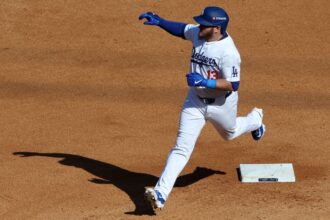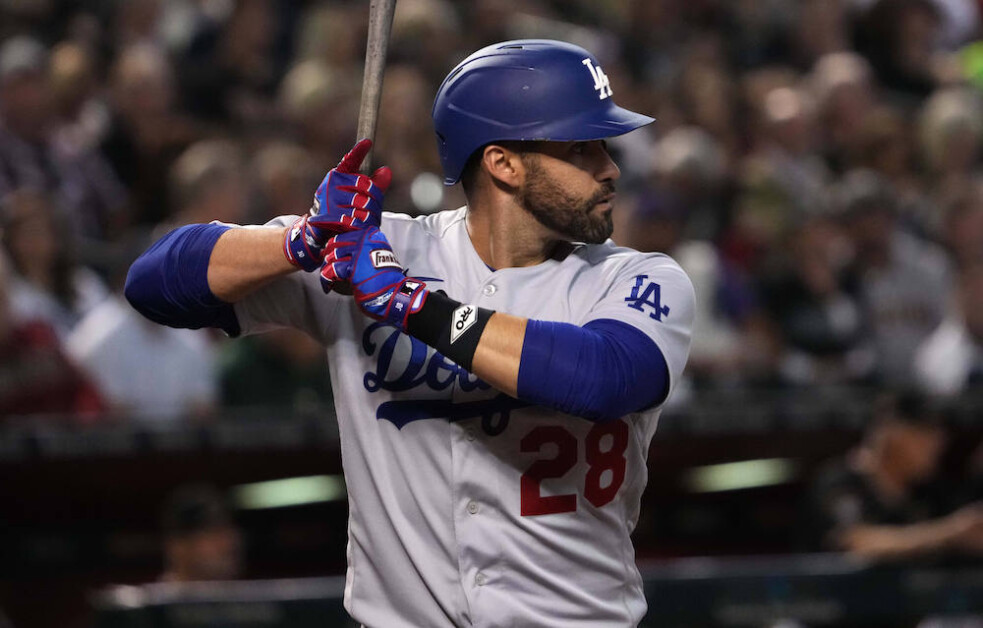


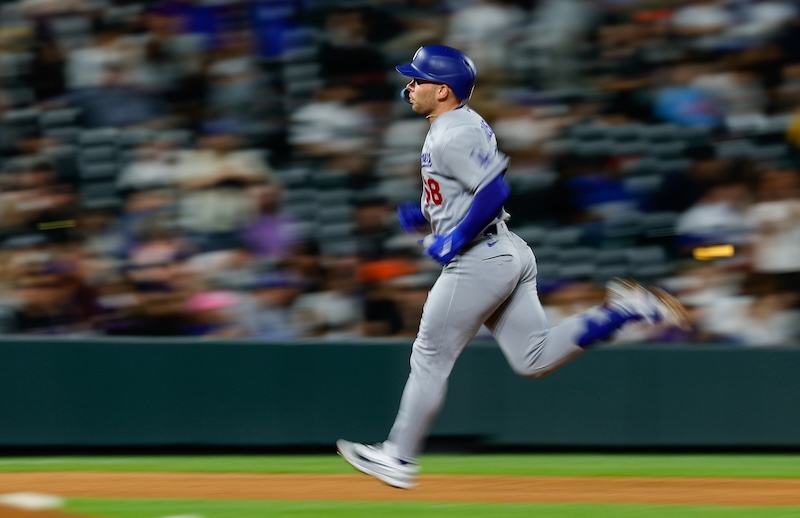
How can the Dodgers carve out more at-bats for Dalton Rushing without disrupting a roster built to chase another title? The answer lies in treating him less like a traditional backup catcher and more like a bat the lineup has to serve.
The Dodgers are again among the favorites to win it all in 2026, with several sportsbooks listing them as the World Series favorite at around +200 to +210, including Bet Casino.
That context matters. Contending teams usually lean on established stars, but Dalton Rushing is making it harder to keep him in a part-time role.
Through his two home run performance tonight against Colorado, he is hitting .444 with 12 hits in 44 at-bats, with seven home runs, 13 RBIs, and a 1.760 OPS, a sharp contrast to the .204 average, four homers, 24 RBI, and .582 OPS he posted over 142 at-bats in 2025.
Rushing’s Offensive Breakthrough
Rushing’s bat is the reason this conversation exists. His 2025 rookie season showed flashes but never fully came together, as he struggled to find rhythm and consistency in a limited role. This year, his production has spiked. He piled up seven hits in his first 13 at-bats and hasn’t stopped producing, with power to all fields and far better swing decisions.
The Dodgers do not need him to be an offensive centerpiece. They need him to lengthen a lineup that already features stars at the top. When Rushing hits like this, opposing pitchers lose soft landing spots at the bottom of the order. That type of depth often separates true contenders in October, especially when game plans revolve around neutralizing the top three or four hitters.
Catcher Starts When Will Smith Rests
The most straightforward path to more playing time is at Rushing’s natural position. Will Smith remains one of the best catchers in baseball and will continue to handle the bulk of the workload. But the Dodgers can be more intentional about when and how they rest him to create regular starts for Rushing behind the plate.
Instead of sporadic off days, the club can treat Smith’s rest like part of a rotation. That could mean targeting day games after night games or stretches in tough travel spots as automatic Rushing starts. Those planned opportunities help Rushing prepare and avoid the feeling of spot duty that marked much of last season. They also protect Smith for the long grind and a potential deep postseason run.
Using Rushing as a true No. 2 catcher, rather than an emergency option, also gives the coaching staff more data on how he handles different pitchers and game situations. That information matters when October arrives, and the Dodgers may need a different in-game look or a pinch-hit option who can also stay behind the plate.
First Base as a Secondary Home
The Dodgers have already signaled that Rushing’s secondary spot is first base, which opens another lane to at-bats. Freddie Freeman still plays as often as anyone in baseball, but first base is naturally a position where a veteran can benefit from occasional rest days and late-season workload management.
Rushing can start on the scheduled Freeman off days first. He can also slide in when the Dodgers want to use Freeman at designated hitter to keep his bat in the lineup while easing the physical toll. Those first base reps serve two purposes. They get him into the lineup without removing Smith, and they allow the team to evaluate whether he can be a credible defender at the position in higher-leverage situations.
If Rushing proves reliable at first, that flexibility becomes a weapon. The Dodgers can react more aggressively to in-game matchups, knowing they have multiple ways to rearrange the corner infield and catcher spots without sacrificing too much defense.
Spot Starts and Matchups at Designated Hitter
Designated hitter may be the cleanest way to add plate appearances without reshuffling the defensive alignment. The Dodgers often cycle multiple players through the DH spot, using it as a partial rest day for regulars. Rushing should be part of that mix whenever there is a favorable matchup.
Against right-handed pitchers in particular, the Dodgers can prioritize Rushing if his early splits hold or even normalize to league-average power with strong on-base skills. That could mean sitting a struggling right-handed bat for a day or pushing a regular into the field instead of DH to make room. The key is to view DH as a spot that can and should be used to develop and leverage Rushing’s bat, not only as a rest slot for established stars.
Leveraging Off Days and Soft Spots in the Schedule
Schedule management offers another subtle way to increase Rushing’s playing time. The Dodgers can target stretches with weaker opposing pitching staffs or long runs of right-handed starters and pre-plan more Rushing starts during those windows.
Building a loose playing-time map a few weeks ahead can help. It allows Rushing to anticipate when his name will be in the lineup, supports his routine, and makes the playing time feel earned rather than random. It also keeps the rest of the roster on a predictable rhythm, which is important in a clubhouse full of veterans who value structure.
Why Finding the Extra At-Bats Matters
All of these ideas share a common theme. The Dodgers do not need to overhaul their roster to get Dalton Rushing more time. They need to treat his development and impact as an active priority rather than a luxury.
Getting him regular, if still modest, runs at catcher, first base, and DH can pay off in several ways. It deepens the lineup, protects key veterans, and gives the coaching staff more flexibility in how they attack individual games and playoff series. It also sends a message to a young player that his performance, from a tough 2025 to an explosive start in 2026, matters and that there is a path to a larger role if he continues to produce.
For a team sitting at the top of the World Series odds board, those incremental gains can be decisive. The Dodgers can protect what already works while still finding more room for a bat that is forcing the conversation.